
There are certain things smart founders do right after they launch their product that almost every other founder completely messes up - and it gives them an unfair advantage.
I’ve built 2 startups myself and coached over 50 founders, and the truth is: What you do in the first weeks after launch is often more important than what you did to get the product shipped.
If you get this phase wrong, you can quietly kill a great product.
The problem is, there's a lot of really bad advice out there. I keep seeing founders told to use ads right away, add more features, or start fundraising the moment they go live.
I've watched many good products fail because founders followed this generic, growth-hacky nonsense that no truly experienced founder would ever recommend.
So, I decided to show you 10 things that actually matter after launching your product - the things that make a real difference and make sure you’re not quietly killing your startup.
Let’s dive into it right now.
SEE ALL MY STARTUP RESOURCESI’ve built 2 startups myself and coached over 50 founders, and the truth is: What you do in the first weeks after launch is often more important than what you did to get the product shipped.
If you get this phase wrong, you can quietly kill a great product.
The problem is, there's a lot of really bad advice out there. I keep seeing founders told to use ads right away, add more features, or start fundraising the moment they go live.
I've watched many good products fail because founders followed this generic, growth-hacky nonsense that no truly experienced founder would ever recommend.
So, I decided to show you 10 things that actually matter after launching your product - the things that make a real difference and make sure you’re not quietly killing your startup.
Let’s dive into it right now.
1. Define what "Winning" looks like
The first thing you need to do immediately after launch is define what "Winning" actually means.
And no - "Get more users" doesn't count.
You need one or two hard metrics that tell you whether your product is working or not. For example:
✅ How many people used your main feature
✅ How many people are still using your product after 7 days
Here's why this matters:
For the next 30 days, you'll have a ton of new ideas - features, tactics, things you could do. If you don't define winning, you have no idea what actually matters.
And that's how you lose weeks and a ton of time and money doing the wrong things.
So, metrics become your decision filter. If an idea doesn't move your metrics, you skip it. Simple as that.
------------------------------------------------------------------------
Now some of this might feel like a lot to handle on top of everything else you’re already doing as a founder.
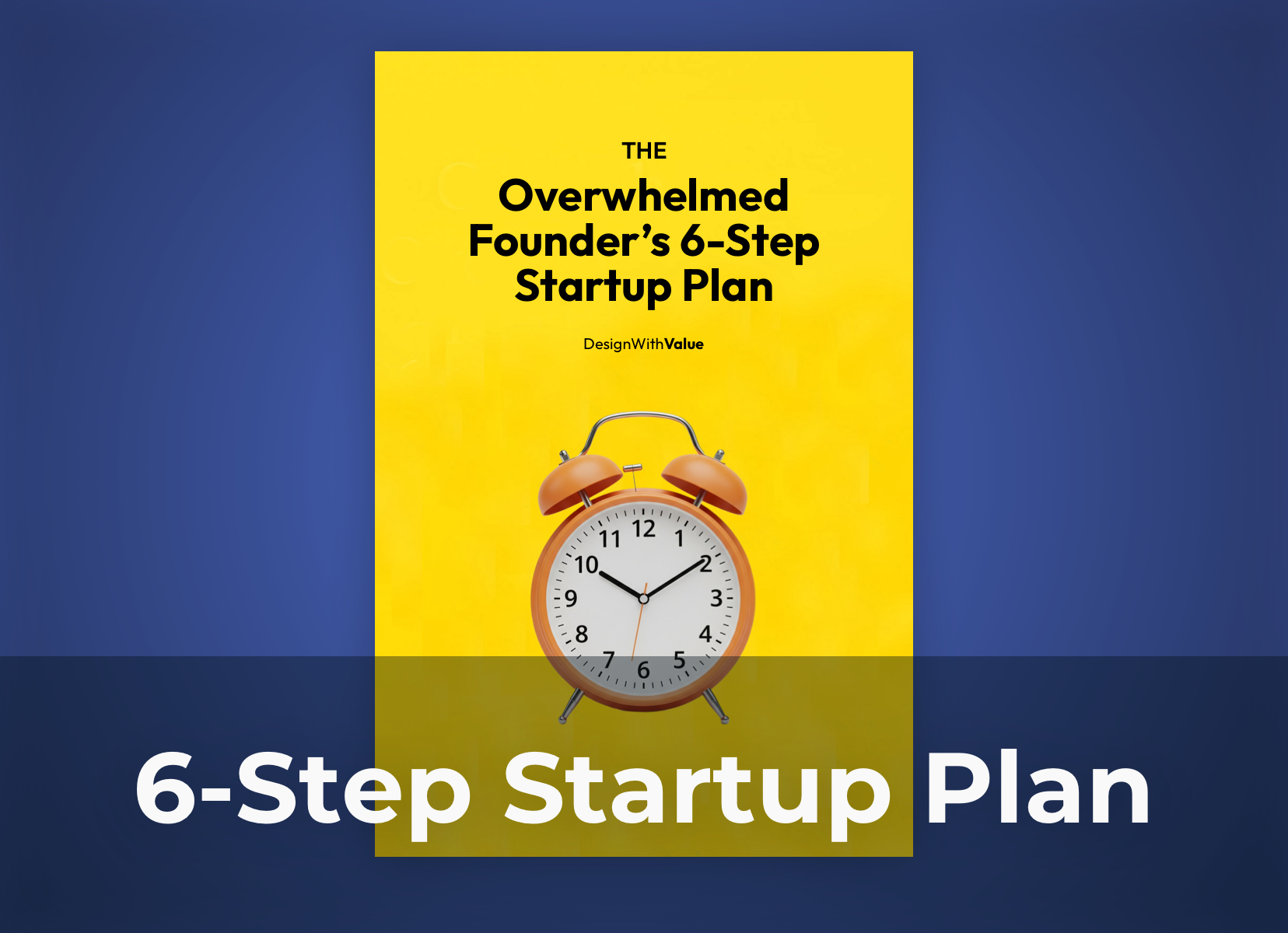
So if you want a simple, bigger-picture roadmap that tells you what to focus on in which order - not just after launch but across your whole startup – I’ve put together a 6-step startup plan. You can download it for free.
2. Look at where people get stuck
Once you know what winning looks like, find where people are getting stuck.
Map the exact path people take through your product.
For example:
→ They visit your website
→ Download the app
→ Sign up
→ Use your product
But where do they stop?
❌ Are people visiting but never downloading?
❌ Signing up but never using it?
You want the real numbers.
And you don't need a fancy dashboard for this.
A simple spreadsheet works fine.
So, if half your visitors never download, fix your copy.
If people sign up but never use it, simplify your onboarding.
The goal here is not to fix everything at once. You want to fix the biggest problem first - the moment where most people drop off.
And once you know where people are stuck, you need to actually talk to them to understand why.
3. Get on calls with your early users
Now, this one’s a big one because it’s one of the most important things you need to do right after launching your product.
Get on calls with your early users right now.
→ Let them share their screen
→ Watch them click around
Don't explain. Don't defend. Just watch.
Write down everything you notice - when they pause, when they ask a question, when they say "Wait, what is this?"
This teaches you more than any dashboard because it shows you exactly what's broken and where your product confuses people.
These are the things we want to fix first.
4. Ship a few fast, surgical fixes
After talking to some early users, you should see where people don’t understand your product or where they drop off.
These are your first fixes.
❌ So don't plan big features yet
✅ Only fix small things that help people get value faster
For example:
→ Remove confusing steps
→ Make forms shorter
→ Make the first win easier
And always make sure you ship fast.
Don’t spend weeks on small features.
It’s better to fix things quickly and get feedback early - even if it’s not perfect. Every update that gets more people to sign up or keeps them with you longer is a win.
5. Talk to people who left
This is the part most founders skip. But it’s a big mistake.
They only talk to active users because they think that’s the only thing that matters. But the people who left are equally important.
Because they show you exactly what you need to improve.
So, send them an email and ask why they left.
Here’s a simple email you can literally copy and paste:
---------------------------
Hi there,
Hope you’re doing well! I’m the founder of [Product], and I noticed you stopped using it recently, so I wanted to personally reach out.
If you’re open to sharing, I’d love to hear what made you decide to leave. Even a quick note would really help me improve things.
Thanks so much for giving it a try - I really appreciate it.
Best,
[Your Name]
---------------------------
Most people won't reply.
But the ones who do will show you exactly what to fix.
And here’s the good part: The exact words people use when they reply will become some of your best sales copy.
They only talk to active users because they think that’s the only thing that matters. But the people who left are equally important.
Because they show you exactly what you need to improve.
So, send them an email and ask why they left.
Here’s a simple email you can literally copy and paste:
---------------------------
Hi there,
Hope you’re doing well! I’m the founder of [Product], and I noticed you stopped using it recently, so I wanted to personally reach out.
If you’re open to sharing, I’d love to hear what made you decide to leave. Even a quick note would really help me improve things.
Thanks so much for giving it a try - I really appreciate it.
Best,
[Your Name]
---------------------------
Most people won't reply.
But the ones who do will show you exactly what to fix.
And here’s the good part: The exact words people use when they reply will become some of your best sales copy.
6. Use worries to help you sell
Here’s a pro tip from my second startup:
Every time someone hesitates or says no, write it down - word for word. Over time, you'll see the same worries repeating.
Then use those exact words to sell your product.
Use them in your emails, when you talk to people, on your website, and in your FAQ section.
You’re basically answering questions before people ask them. That builds trust - which makes more people use your product.
7. Decide what you WILL NOT build next
Now, when you talk to customers, they'll ask for lots of things:
• Dark mode
• Offline mode
• "I want all buttons green"
Most are distractions. Write them all down.
And then put most of them aside.
Remember you defined what winning looks like in the beginning.
So, if it doesn’t help you move closer to your goal, skip it for now.
And don't worry – you're not killing these ideas forever.
Just put them in a "someday" folder in your backlog.
But there are certain things you should definitely build - the things your customers actually care about.
Here’s how to find them.
8. See who is still using your product
After a few weeks, look at who's still around.
Not who signed up - but who's actually still using your product.
Look at what they have in common. Do they have the same job, the same problems, or the same reason they care?
This tells you who your product is actually for - not who you hoped it was for. Most founders think they know their customers - until they check the data.
So, find out who is still using your product after 30 days and look for the patterns.
9. Save the good things
This is one of the pro tips I learned a couple of years ago. Any time something good happens, save it – nice emails, good messages, happy customers, small wins.
Just screenshot it.
And then use it later on your website as proof.
Or like I do – keep a folder of nice emails and compliments that remind you why you're doing this when things get hard.
So, make it a habit to screenshot these things as you go.
But screenshots alone aren't enough.
There is one even more powerful thing smart founders do right after launch.
10. Document everything you learn
Create a 'post-launch playbook' where you record what worked, what didn’t, and why. You’ll use it as your startup grows.
Here's why this is important:
Right now, you're learning faster than you ever will again.
✅ You're talking to users
✅ You're shipping fixes
✅ You're seeing what works for your startup
But if you don't write it down, you'll forget it.
Most founders don't do this. They just move on to the next thing.
But the best founders I know keep their learnings in a simple document. Maybe it's a Google Doc. Maybe it's a Notion page. Doesn't matter.
What matters is you capture three things:
→ What worked. Like, "When we simplified the signup form, retention went up 15%." Write it down.
→ What didn't work. Like, "We added dark mode. Nobody asked for it. We wasted two weeks." Write it down.
→ And why. Why did it work? Why didn't it? What did you learn about your users or your product?
Six months from now, when you're building your next feature or your next product, you'll have a playbook. You won't have to relearn the same lessons.
And if you ever coach other founders or hire a team, you'll have proof of what actually works for your business. So, open a document and every week, spend 15 minutes logging what you learned. That's it.
What’s next
So now you know what smart founders do immediately after launching.
But the hard part usually isn’t understanding this stuff - it’s knowing how to apply it week by week without second-guessing yourself.
When I was building my own startups, I kept wishing for a simple roadmap that told me exactly what to focus on next at each stage of my startup.
That’s why I put everything I use into my Startup Success Bundle.
It’s a clear, proven roadmap already used by 50+ founders to help you build your startup without feeling stuck or overwhelmed.
Click the button below to get instant access.
But the hard part usually isn’t understanding this stuff - it’s knowing how to apply it week by week without second-guessing yourself.
When I was building my own startups, I kept wishing for a simple roadmap that told me exactly what to focus on next at each stage of my startup.
That’s why I put everything I use into my Startup Success Bundle.
It’s a clear, proven roadmap already used by 50+ founders to help you build your startup without feeling stuck or overwhelmed.
Click the button below to get instant access.
