
If you want to crush your product launch and not end up with 0 users, this is for you.
In the next few minutes, I’ll show you the exact launch plan to get your first users. No generic "post on social media" fluff, but clear action steps you can take right now.
I’m Oskar. I’ve built two startups and coached more than 50 founders through their product launches. The tactics I’m about to show you are the same ones I use with them.
I’ll show you exactly what to do in pre-launch, what to do during launch week, and how to follow up so those first users actually show up.
Let’s dive into it.
SEE ALL MY STARTUP RESOURCESIn the next few minutes, I’ll show you the exact launch plan to get your first users. No generic "post on social media" fluff, but clear action steps you can take right now.
I’m Oskar. I’ve built two startups and coached more than 50 founders through their product launches. The tactics I’m about to show you are the same ones I use with them.
I’ll show you exactly what to do in pre-launch, what to do during launch week, and how to follow up so those first users actually show up.
Let’s dive into it.
The Setup
We'll break this into three simple phases.
✅ Pre-Launch
✅ Launch Week
✅ Post-Launch
And if you follow this, you won't just have "traffic".
You'll have real people using your product.
Now, most founders think a product launch is this massive event where you go viral and get a million users overnight. But that’s a trap.
Real growth works like this:
You get 10 users, talk to them, fix what’s broken, and then get 10 more.
So, forget complicated marketing strategies for a second - we are going back to basics. And we are going to start with the phase that decides if your product launch even has a chance to get users.
PHASE 1: Pre-Launch
Most founders skip this. They just put a link on Twitter and pray someone signs up for their product.
And then - well - they get 2 or 3 likes but still no users.
❌ So, we're not just throwing links out and pray.
✅ Here's exactly what you need to do in pre-launch - 3 simple steps.
Step one is to define WHO you are launching to.
And "everyone" is not an answer.
Now let’s make this concrete. I want you to open a Notion or Google Doc right now. Write down the names of your first 10 ideal users. These can be friends, former colleagues, or people you’ve seen complaining about the problem on LinkedIn.
This is important - because if you can't name 10 specific people who need your product, you're not ready to launch.
Step two is to be super clear about your offer. You need one sentence that explains why those 10 people should care. Right below those 10 names, write your one-sentence offer:
Here is a template I use with every founder I coach:
"I help [PEOPLE] who struggle with [PROBLEM], to achieve [OUTCOME] by [HOW]."
Here is an example:
"I help freelance designers who struggle with chasing payments, to get paid twice as fast by automating their invoice reminders."
Do you see what's happening here?
✅ It’s specific
✅ It’s clear
✅ A 9-year-old would understand it
And step three - you build the minimum assets to show your product.
But this is important - don’t spend three weeks building a perfect website. You just need a simple landing page where people can sign up, a short video that shows how your product solves the big problem - no fancy editing, just your screen and your voice - and 5 images you can use to promote your product.
So quick recap. You have...
✅ your list of 10 people
✅ your one-sentence offer
✅ your website
✅ a demo video
✅ 5 images to promote your product
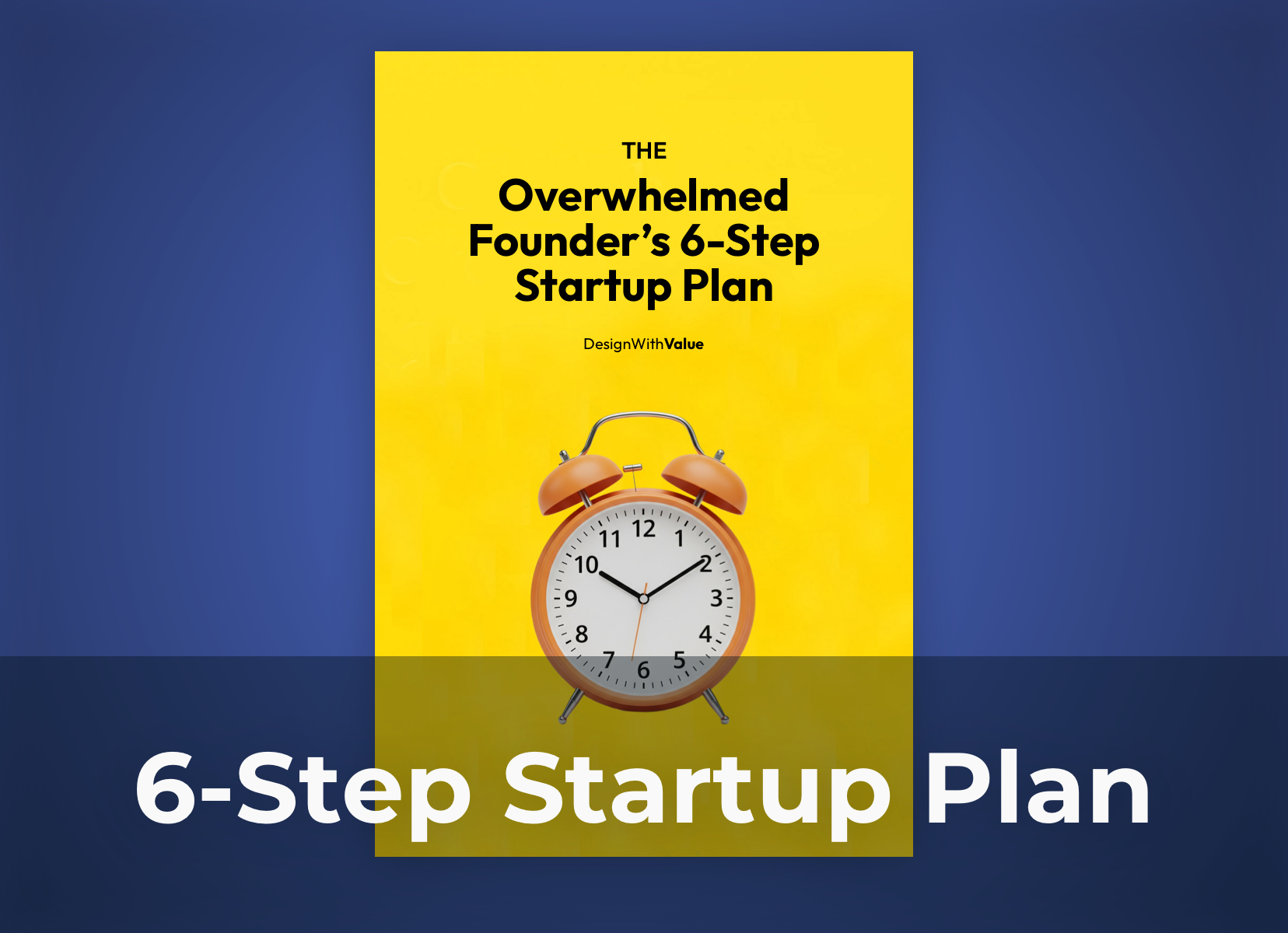
Real quick - if you want a simple plan that shows you step by step what to do next in your startup, I made something for you. It’s called my "Overwhelmed Founder’s 6-Step Startup Plan".
It shows you what to focus on and what you can ignore, so you can make real progress without wasting your time or money. You can download it right here.
Now let's move on to the launch week.
PHASE 2: Launch Week
The goal here is to use what we have prepared and get our first real signups. Now, we are going to split your launch week into three parts.
First, Day 1 and 2: The soft launch.
Don't post publicly yet. First, take that list of 10 people you wrote down in Phase 1. Send them a personal message. Not a mass email. A personal message.
Say something like:
"Hey Steven, I built something to help with [Problem]. Since you deal with this a lot, I’d love for you to try it out. Here is a 1-minute demo. Let me know if you want the link."
Then you send them the link to your video.
That’s it.
→ You are warming them up.
→ You are validating that real people actually care before you let everyone else know.
Now, Day 3 and 4:
This is where you go to LinkedIn, Twitter, or the specific platforms where your users hang out.
But here is the trap you need to avoid:
Don’t just post "My product is live, check it out."
Because nobody cares.
You need to show people what they gain from using your product.
This is where your one-sentence offer comes in.
You can use this exact script for your LinkedIn or Twitter post:
"I noticed that [Target Audience] wastes hours every week doing [The Problem]. I spent the last months building a simple tool to fix this. It’s called [Product Name]. It helps you [Outcome] without [Common problem]. I’m looking for 10 beta users to test it out. Comment 'ME' below and I’ll send you the access link."
And you simply add one image you created during the pre-launch week.
Do you see why this works?
❌ You are not just dumping a link.
✅ You are asking for engagement.
✅ You are showing people how you can help.
And on day 5 to 7 you amplify what works.
By now, you should have a few people trying the product. So, take a screenshot of your first signup email. Or a nice message someone sent you.
Or just a photo of you working on the bug fixes.
Post 2 images each day and link to your product.
Keep the momentum.
And if you do this right, you finish the week with actual users, not just a couple of likes.
Let’s move on to the post-launch.
PHASE 3: Post-Launch
Your launch week is over.
Most founders think they are done.
And that’s why most founders fail.
They get a few users, and then they immediately go back to coding new features. But that is completely the wrong way.
Your goal now is to use these first users to learn how you can improve your product. So, your number one action is to talk to every single new user.
Doesn't matter if it's 5 people or 50.
Message every new user personally.
You can simply send them a message and ask them these 3 questions:
✅ What made you sign up?
✅ What confused you?
✅ What almost stopped you from trying it?
These answers are pure gold.
Because they will tell you exactly why people are buying, and exactly why others are leaving.
Once you have those answers, your job is to fix the biggest blocker.
→ Like, is everyone getting stuck on the sign-up page?
→ Is everyone confused by the dashboard?
Pick the ONE biggest problem and fix it this week.
Maybe you need to change the text on your call-to-action button.
Maybe you need to add a "how-to" video.
Make one simple change to make the product better for the next person who signs up.
And action number three is to turn your happy users into a small growth loop. Find the 3 to 5 users who use your product the most. Reach out and ask this question:
"Do you know one or two other people who have this same problem and might want to try this?"
To make this even more successful, you can offer them a simple incentive like extended free access or direct support from you. You don't need a complex referral system. For now, you just need to ask.
If your product is good, they will say yes.
This is how you turn 10 users into 20, and 20 into 40.
What's next
Here is the important part. Don't get obsessed with "I need more traffic."
If you have 1000 visitors and nobody signs up, that’s worthless. Get obsessed with helping the people who already signed up and keeping them. If you can make them happy, you have a business.
But the hard part usually isn’t understanding this stuff - it’s knowing how to apply it week by week without second-guessing yourself.
When I was building my own startups, I kept wishing for a simple roadmap that told me exactly what to focus on next at each stage of my startup.
That’s why I put everything I use into my Startup Success Bundle.
It’s a clear, proven roadmap already used by 50+ founders to help you build your startup without feeling stuck or overwhelmed.
Click the button below to get instant access.
If you have 1000 visitors and nobody signs up, that’s worthless. Get obsessed with helping the people who already signed up and keeping them. If you can make them happy, you have a business.
But the hard part usually isn’t understanding this stuff - it’s knowing how to apply it week by week without second-guessing yourself.
When I was building my own startups, I kept wishing for a simple roadmap that told me exactly what to focus on next at each stage of my startup.
That’s why I put everything I use into my Startup Success Bundle.
It’s a clear, proven roadmap already used by 50+ founders to help you build your startup without feeling stuck or overwhelmed.
Click the button below to get instant access.
