If you're building a startup and don't know if you should run ads, do content or cold outreach to get customers, the Bullseye Framework is exactly what you need.
Gabriel Weinberg built it, and it's one of the strongest frameworks for startups. It helps you find the one marketing channel that actually gets you paying customers - and most of the time, it's not what you think it is.
I’m Oskar, I have built 2 startups and coached over 50 founders.
Let me show you how the bullseye framework works, and how you can use AI to find this one channel really fast.
It works like this…
Gabriel Weinberg built it, and it's one of the strongest frameworks for startups. It helps you find the one marketing channel that actually gets you paying customers - and most of the time, it's not what you think it is.
I’m Oskar, I have built 2 startups and coached over 50 founders.
Let me show you how the bullseye framework works, and how you can use AI to find this one channel really fast.
It works like this…
The big problem
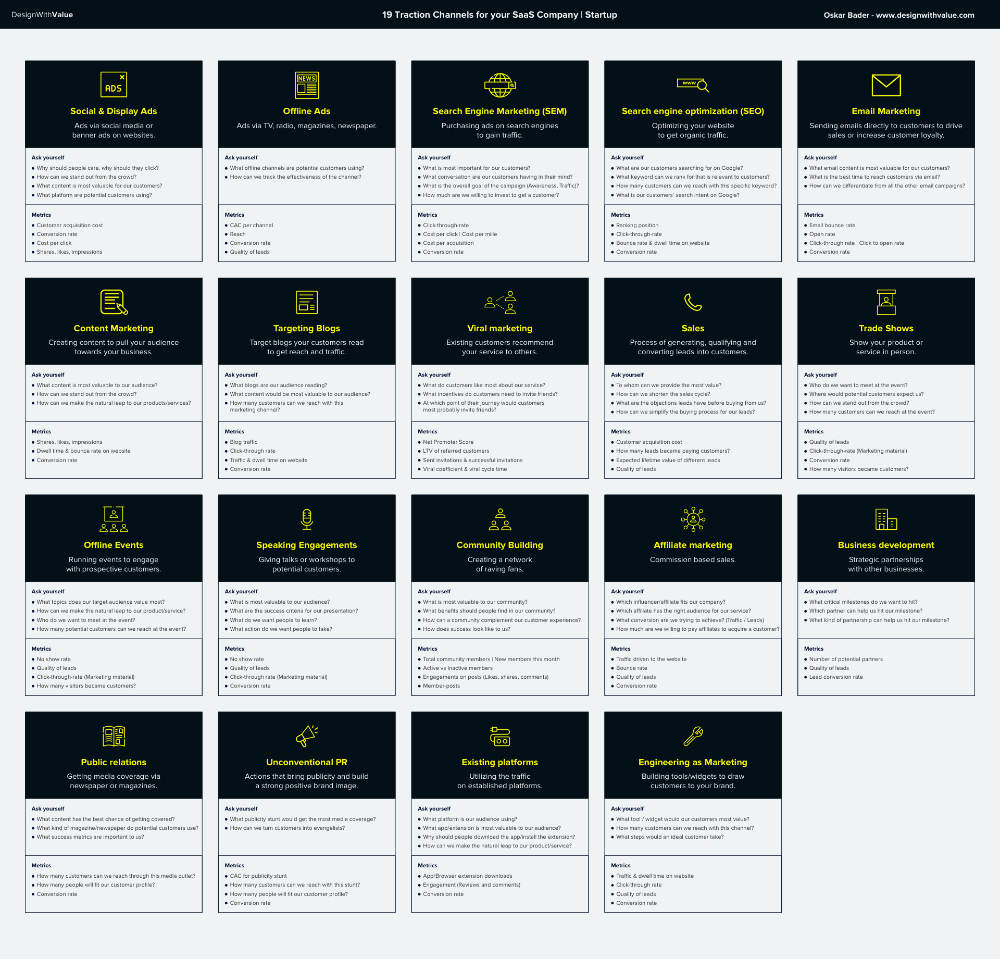
There are 19 marketing channels you can use to get customers.
Content, SEO, cold email, paid ads, communities - the list is long.
And here comes the big issue:
Most founders don’t know which one they should use. So, they do everything. They do a bit of content here, some cold outreach there,
some ads on the side - I mean they could work right?
Six months later and they still have zero paying customers.
Sounds familiar?
So, what should you do instead?
How do you actually find this one channel that gets you paying customers for your startup? That's exactly what Gabriel Weinberg's framework solves.
The better way
Instead of using ads, content and cold outreach all at the same time - you focus. One channel. The one that actually gets you paying customers.
The bullseye framework has three rings - picture a dartboard.
In the outer ring are the 19 marketing channels. For each channel you brainstorm ideas that could work.
For example, if social media advertising, inbound marketing or direct sales could be interesting for your startup - some ideas for these channels could be:
• Creating ads that lead people to your product
• Using blog articles to drive organic traffic to your website
• Calling potential customers directly and showing them your product
You put those ideas in the outer ring.
Now you move your top 3 ideas in the middle ring.
Those are your best bets, based on your experience and knowledge.
Why three?
Because testing just one is risky - if it doesn’t work, you're back to zero.
And if you test ten at once, you lose focus. Three is the sweet spot.
Then you quickly test those ideas and put the winner in the inner ring.
That's the whole framework. Three rings.
And you focus on the inner one.
It's a super strong framework but honestly - it used to take days to fill it out. Now with AI - you can do it in 30 minutes.
I will show you the exact prompts I use - so you can copy paste this - but if you want a quick overview of all the marketing channels you could use - I made a free worksheet - you can download it here:
Use this prompt to find the best channel
Here's the exact prompt you can copy and paste. I'm using Claude but you can use whatever AI tool you like - it works the same way.
And let me make this concrete - let’s say I've built a reporting tool for small marketing agencies. It pulls data from Google Ads and builds a client report in one click - and it saves agency owners about five hours a week.
Here's what I feed the AI:
• My product, in one sentence.
• My target audience.
• My goal - 100 paying customers in 90 days.
• My current traction - the product is live, I have 20 free users, zero paying customers, and I already tried LinkedIn content for two weeks.
• My budget is €500 a month, and it's just me, solo founder.
Then I give it three tasks:
Task one:
"Grill me: Before it gives me anything, I want 10 sharp questions that fill the gaps in my answer." It has to wait for my answers before it moves on - no framework yet.
Most founders skip this step. They ask AI what marketing channel they should use straight away. And they get back a generic list that could apply to any startup. This step forces the AI to actually understand your specific situation before it gives you anything.
Task two:
"Build the outer and middle ring. In the outer ring - all 19 marketing channels, with 1 strong idea for each marketing channel - plus one-line why this idea can work for my specific startup. Then narrow that down to the top three ideas worth testing, with what it actually costs to get one paying customer, if I can reach enough people with that idea and if my customers are really there."
The inner ring stays empty for now. We will do the tests ourselves.
Task three:
"Build me a two-week test plan for each of those three middle-ring ideas. Daily actions. What to measure. So, I can test fast, fail fast, and actually know if the idea works for my startup."
Now here's where it gets interesting.
Remember what I said at the start?
Most of the time, the channel isn't what you think it is.
When I started, my gut told me to just write blog articles to get more people to my website and then lead people to my product. I was writing blog article after blog article but barely got paying customers. But when the AI ran the outer ring, it noticed something I hadn't looked at properly - my two closest competitors, aren't winning through SEO.
They were using content on social media to build trust.
So instead of telling me to write more blog articles, the middle ring came back with ads, cold email, and social media content to build trust as the top three to test - not SEO.
Now here is what you do after AI built this plan ...
What to do after AI
AI can give you a couple of proven ideas and that’s good - but it cannot tell you if it really works for your startup. You need to test it yourself.
So, take the two-week plan for each middle-ring idea and test it.
Post the content. Reach out to people.
Track the exact metrics AI gave you - and see what works.
Now, here are 2 pro tips you need to know:
1. You want to test this quickly - 2 weeks - not 6 months.
And you want to test it cheaply. You don’t want to spend €5k on ads.
You basically want to test this quick and cheap and see if it works for you.
If it doesn’t, you go for the next idea.
And if it does work, you double down on it.
2. Once you found a winner, cut everything else.
You don’t need 5 more ideas that could work. You only need one idea for now. And later on, once you have your one big winner, and you scaled it, you can add a new idea.
Your next step
Instead of going for ads, content, SEO and partnerships all at the same time, focus on one channel - one channel that really brings you paying customers.
Use the prompt I showed you, quickly test the ideas in the middle ring and double down on what works. That’s how you get your paying customers and not waste your time and money.
Now, if you want help with all of that - check out my startup mastermind.
You’ll get a clear roadmap so you know exactly what to focus on in your startup, personal coaching from me, and you can talk to other founders to see what worked for them.
You can join here: