
If you have a startup idea - here's exactly what to do next, step-by-step.
By the end, you’ll have a simple plan to get your first paying customers.
Because the hardest part isn't having the idea, it's knowing exactly what to do next to make it real.
We’ll go through five steps:
→ Define who has the pain
→ Validate your idea
→ Pre-sell it
→ Build the smallest possible version (your MVP)
→ Get your first 5–10 paying customers
Let's jump straight into it!
SEE ALL MY STARTUP RESOURCESBy the end, you’ll have a simple plan to get your first paying customers.
Because the hardest part isn't having the idea, it's knowing exactly what to do next to make it real.
We’ll go through five steps:
→ Define who has the pain
→ Validate your idea
→ Pre-sell it
→ Build the smallest possible version (your MVP)
→ Get your first 5–10 paying customers
Let's jump straight into it!
Step 1: Define who has the pain
First, we need to define exactly who has this pain. And we do this for one reason: To make sure you are building for a specific person you can actually find and talk to, not a vague "everyone".
So, you need to really zoom in on the person losing sleep over it.
And you do this by answering these three questions:
→ Who exactly has this pain?
Be specific.
❌ "Small business owners" is useless.
✅ "Agency owners with 5–10 employees who are losing clients because of bad reporting" is a target.
You need that level of detail.
→ When does it hurt?
• Is it when they try to invoice clients at the end of the month?
• When they onboard a new team member?
• When do they hit that "I hate this" moment in their week?
→ Where do they hang out right now?
• Are they in specific Slack communities?
• On LinkedIn?
• In a niche subreddit?
You need to know exactly how you can reach them.
This is your foundation.
But before you build anything, you need to prove it's true.
You need to prove that those people would pay for your solution.
And here's where many founders stumble after this crucial first.
Step 2: Validate before you build
After you have found your startup idea - this step is crucial because if you skip it, you risk burning six months and a hundred grand, like I once did, only to realize you built something nobody wants.
You need to validate that people will pay for your solution.
And it’s really simple.
You just need to talk to 10 potential customers.
❌ Not with online surveys and not with friends.
✅ Real people you defined in step 1.
During these conversations, here’s the rule:
Don’t pitch your idea.
You simply want to understand how they deal with the problem right now.
Don’t ask "Would you use my app?"
Ask, "Tell me about the last time you struggled with this problem. What did you do? How did it make you feel? What solutions did you try?"
That's how you validate your idea. But validating your idea by asking a couple of questions is not enough - we take it a step further.
It’s time to make some money (already).
------------------------------------------------------------------------
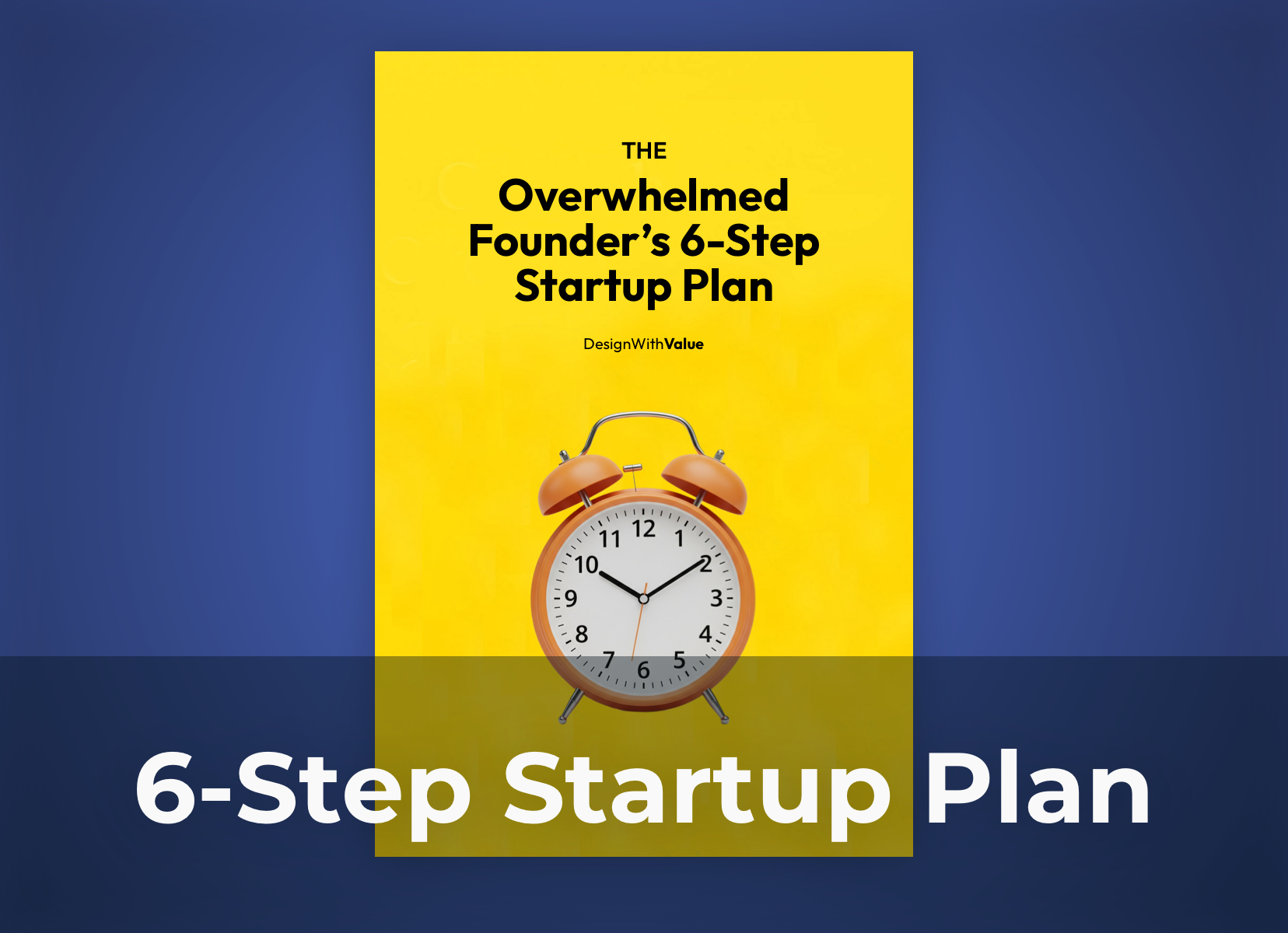
Real quick - if you want a simple plan that shows you step by step what to do next in your startup, I made something for you: It’s called my "Overwhelmed Founder’s 6-Step Startup Plan".
It shows you what to focus on and what you can ignore, so you can make real progress without wasting your time or money.
You can download it right here.
Now let's move on to the next step.
Step 3: Pre-sell before you build anything
Ok - this next step is absolutely vital. Because a few questions can validate your idea, but this is the ultimate proof of demand.
You pre-sell your idea.
But how do you presell your idea when you don’t have a product yet?
The easiest way to pre-sell is a landing page.
And you can make it super simple.
Your goal here isn't design awards.
You simply show the clear pain point you solve in the headline, write a quick sub-headline to make it more clear - show 3 bullet points to show the beneftis of your product, a screenshot or a quick draft and asks for one thing:
An email address for a waitlist.
But what do they get for joining the waitlist?
Anything that is valuable to them. For example:
✅ Beta access
✅ 3 months for free
✅ Free premium features
Just be super clear they're getting early value and that your product is still in progress.
Building such a waitlist is a great way to build a community early on - and once you release your product you can send those people an email and get first customers.
But here’s an even better way: Try to get a first payment.
This is the ultimate early product test.
→ "Pay €20 now to lock in your early-access spot" or
→ "Pay a one-time fee of €49 for early access and priority support"
If you can get 5 to 10 people to pay for something that doesn't exist yet, you've hit gold.
The big mistake here many founders make is thinking you need to build a fully functional product with a ton of features to get people to pay.
You don't.
You simply need to show how your product will help them.
And if you got your first 20 people in your waitlist or 5 paying customers, then - and only then - you can move on to actually building.
But you need to build it right.
Step 4: Build the smallest possible version
In step 4 you finally build your product.
But this is where most founders go wrong.
They want to make their product perfect.
So, they spend 6 months to build every possible feature they can imagine.
This is a huge mistake.
Instead, you build an MVP - the smallest possible version of your product. Your MVP, should do one thing exceptionally well.
Nothing else. Not two things, not three. Just one.
For example, if the problem you are solving is "Losing track of leads in Google Sheets" - your MVP is a simple tool that just sends you a reminder of who to email today - not a full-blown CRM with AI features.
So, you build only this one feature.
The one that solves the pain your customers have.
Everything else is not important right now.
The goal for the MVP is to build it quickly, show it to potential customers and find out if you are on the right track.
You want to learn fast and update quickly instead of building it for 6 months only to find out nobody wants it.
Ok, now you have built your first MVP, even if it’s duct-taped together.
The next step is the most important one.
Because without it - you will never have a successful startup.
Step 5: Get your first 10 paying customers
This step proves people want your product and that you can actually build a successful business.
But what is the best way to get your first 10 paying customers?
Do you need to use ads or use complex marketing?
No.
We make this super easy - and it’s actually one of the best ways to get first customers.
✅ We just talk to people.
Look where your potential customers hang out.
This could be LinkedIn, online communities, reddit or discord, wherever.
Then, reach out to them with a personalized message.
Mention the pain point you’re solving and ask if they have 20 minutes to share how they currently solve it.
For example:
Hey Sarah, I’m speaking with a few small agency owners who often rush client reports at the end of the month. I’m trying to understand how reporting is handled today - what works well and what’s frustrating.
Would you be open to a quick 20-minute call this or next week to share how you currently approach it?
Once you talked to those people you turn those conversations into customers by simply saying “I might be able to help with this. Would it be useful if I showed you what I’m working on?”
Now here is the important part:
❌ Don't spam!
✅ Engage genuinely, provide value, and subtly mention your product when it's appropriate.
If that sounds like a l lot right now - I’ve put together a First 10 Customers Playbook for you to make your life easier - it shows you exactly how to do this step by step.
Now let me tell you this upfront. This is hard work. You will hear "No" more often than you hear "Yes". You will feel frustrated. But every "No" is a chance to learn, refine your message, and get closer to a "Yes".
Your goal is not thousands of customers yet.
It's just those first 10 paying customers.
What's next
These are the 5 steps you need to do after you have found your startup idea. You define who has the pain, you validate your idea before you build, you pre sell your MVP, you build your MVP and you get those first customers.
But the hard part usually isn’t understanding this stuff - it’s knowing how to apply it week by week without second-guessing yourself.
When I was building my own startups, I kept wishing for a simple roadmap that told me exactly what to focus on next at each stage of my startup.
That’s why I put everything I use into my Startup Success Bundle.
It’s a clear, proven roadmap already used by 50+ founders to help you build your startup without feeling stuck or overwhelmed.
Click the button below to get instant access.
But the hard part usually isn’t understanding this stuff - it’s knowing how to apply it week by week without second-guessing yourself.
When I was building my own startups, I kept wishing for a simple roadmap that told me exactly what to focus on next at each stage of my startup.
That’s why I put everything I use into my Startup Success Bundle.
It’s a clear, proven roadmap already used by 50+ founders to help you build your startup without feeling stuck or overwhelmed.
Click the button below to get instant access.
